Choosing a Biological Buffer: Tris, HEPES and MES Compared
Updated 2026-09-20
How the buffer you pick changes enzyme activity, metal-ion availability and assay reproducibility — and how to choose deliberately.
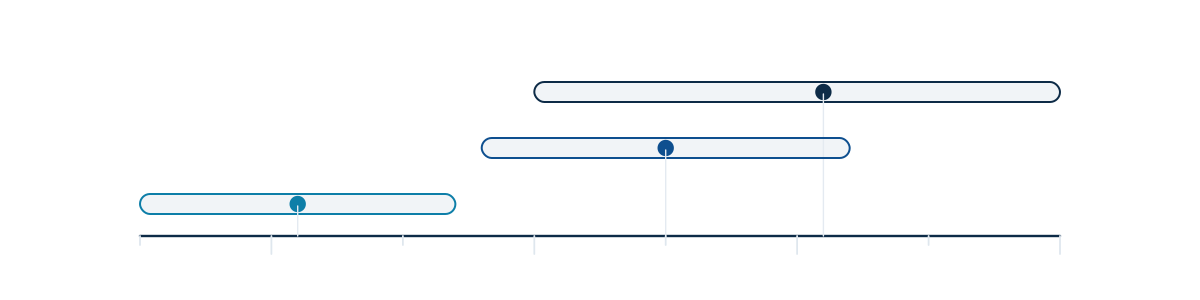
Start from pH, not from habit
Buffering capacity is only reliable within about one pH unit of the pKa. Tris sits near 8.1, HEPES near 7.5 and MES near 6.1 — so the working pH of your assay should select the buffer, not the other way round.
Temperature and interference
Tris has a comparatively large temperature coefficient, so its pH shifts as the assay warms. HEPES has a low temperature coefficient and is preferred for cell work, though it can participate in radical chemistry. MES binds metal ions only weakly, which makes it the better choice where a metal cofactor is essential.
Practical selection map
Nucleic-acid and protein purification: Tris. Cell culture and most enzymology near physiological pH: HEPES. Low-pH enzymology and carbodiimide conjugation: MES. Choosing the wrong buffer typically shows up as unexplained loss of activity rather than an obvious failure.
Purity and trace metals in buffer raw materials
The choice of buffer species is only half the decision; the grade of the solid you dissolve is the other half, and it is the half that quietly ruins experiments. Trace metal contamination matters wherever a metal ion is a cofactor or an inhibitor, and it varies between suppliers and between grades of the same supplier's product. For work involving metal-dependent enzymes, or for conjugation chemistries using divalent cations, a buffer that is adequate in one bottle may be inhibitory in the next. Where a specification is available, look for a stated trace-metal limit rather than an unqualified purity percentage, because 99.5% pure by titration says nothing about the ten parts per million you cannot see. The same logic applies to bioburden and to residual solvent in buffer raw materials intended for reagent formulation, where the impurity profile travels into the finished product.
Buffers that interfere with specific detection chemistries
Some incompatibilities are structural rather than quantitative, and they will not show up as a purity problem at all. Tris contains a primary amine and therefore competes in amine-reactive chemistry, which is why it is a poor choice for many crosslinking and labelling reactions. Phosphate buffers inhibit some alkaline phosphatases and interfere with certain metal-affinity steps. Buffers containing primary amines react with carbodiimide-activated carboxyls, which is the specific reason MES is used in EDC conjugation — not because MES is inert in general, but because it lacks the reactive group that would consume the reagent. Since Good and colleagues introduced the systematic approach to buffer design that these zwitterionic species come from, the guiding principle has been to select a buffer for what it does not do in your system rather than for the pH it happens to hold.
References
These references concern the analytes and the analytical literature — not our materials. Each entry was checked against its PubMed record, and the PMID links to that record so you can verify the details yourself rather than taking our word for it.
- Good NE, Winget GD, Winter W, Connolly TN, Izawa S, Singh RM. Hydrogen ion buffers for biological research. Biochemistry. 1966;5:467-77. PMID 5942950
- Ferguson WJ, Braunschweiger KI, Braunschweiger WR, et al. Hydrogen ion buffers for biological research. Anal Biochem. 1980;104:300-10. PMID 7446957
Related materials
TRIS Base and TRIS-HCl, High-Purity Biological Buffer →HEPES, High-Purity Biological Buffer →MES Monohydrate, High-Purity Biological Buffer →Request a Quote or Sample
Tell us your application, target purity and quantity — we reply within one business day.